
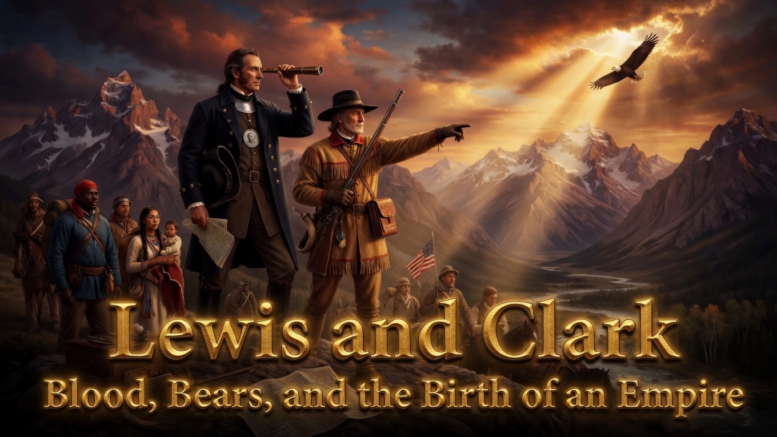
Lewis and Clark: Blood, Bears, and the Birth of an Empire
by Beau Yotty
The year was 1804, and America had just doubled overnight. President Thomas Jefferson, sharp-eyed Virginian with a mind full of stars and sphere of influence, handed Meriwether Lewis a sealed order and a single command: “Find the Northwest Passage, talk to every tribe that’ll listen, and claim the West before the British or the Spanish steal it.” Lewis, a battle-hardened captain with a scientist’s soul, picked his best friend, William Clark, red-haired, map-making son of a Revolutionary War hero, and together they forged the Corps of Discovery. Forty-five men. One flag. Zero excuses.
They shoved off from the muddy banks of the Missouri on May 14, in a 55-foot keelboat and two pirogues, rifles loaded, powder dry, and the future riding shotgun. The river fought them like a living thing, snags that could snap a mast, sandbars that swallowed boats whole, and mosquitoes that rose in black clouds thick enough to choke a man. But these weren’t tourists. These were hard men: hunters, blacksmiths, carpenters, and a one-eyed French boatman who cursed in three languages. Private John Colter could outrun a deer. York, Clark’s freed Black servant turned equal, stood six-foot-four and could wrestle a bull buffalo to the ground. They sang, they swore, they bled, and they pushed west.
By late summer they met the Teton Sioux. The warriors rode up painted for war, demanding tribute. Lewis didn’t blink. He ordered the swivel gun loaded with grapeshot, stepped forward, and gave the speech that would echo across every campfire from here to the Pacific: “We come as brothers under the Great White Father. Trade with us or fight us, your choice. But know this: the United States does not pay tribute to any man.” The Sioux backed down. Word spread. The white men with the thunder-sticks meant business.
Winter hit like a hammer. They built Fort Mandan and hunkered down with the Hidatsa. That’s where they found the key that would open the Rockies: a pregnant Shoshone teenager named Sacagawea and her no-good French trapper husband, Toussaint Charbonneau. Lewis sized her up, quiet, tough as rawhide, eyes that had already seen too much. She’d been kidnapped as a child, sold, and now carried the future in her belly. Clark called her “the woman who makes the men look soft.” She never complained. When the baby came in the dead of winter, she bit down on a leather strap and kept cooking for the entire Corps the next day. Legend.
Spring 1805. The real hell began.
They swapped the keelboat for six dugout canoes and struck into country no white man had mapped. Grizzlies the size of oxen charged them in broad daylight. One nearly took Lewis’s head off; he dropped it at ten paces with a single rifle ball while the rest of the men reloaded. The buffalo herds stretched horizon to horizon, thousands upon thousands. The men ate so much meat they joked their veins ran with gravy. Then the food ran out. They gnawed on candles, boiled moccasins, and still marched.
The Great Falls nearly broke them, eighteen miles of white water and cliffs. They portaged everything: boats, cannons, supplies, Sacagawea’s newborn strapped to her back. Twenty-five days of sweat and blood and busted shoulders. Clark’s maps got better with every mile. Lewis’s journals filled with new plants, new animals, new stars. They were writing America’s first real atlas while starving.
Then the Rockies rose like God’s own wall. Snow in August. Horses dying. Sacagawea, half-starved herself, suddenly recognized the land. “My people,” she whispered, pointing to the peaks. The Shoshone. Her brother, Chief Cameahwait, rode out to meet them. The reunion was raw, tears, embraces, the woman who’d been lost now the bridge between worlds. They traded horses, guns, and promises. The Shoshone guides took them across the Bitterroots on the Lolo Trail, narrow, icy, deadly. Men slipped off cliffs. Horses fell screaming. They ate the last of the colts. Still they marched.
November 7, 1805. The roar hit them before the sight. They crested a ridge and there it was, the Pacific, gray and endless, smashing against the rocks like it wanted to swallow the continent. Clark scratched in his journal the words every American schoolkid should still know by heart: “Ocian in view! O! the joy.” They’d done it. Coast to coast. Two years, four thousand miles, one flag planted where the sun sets.
The return trip was just as savage, hostile tribes, flash floods, a mountain lion that stalked them for three nights, but the Corps was unbreakable now. They had seen the elephant and lived. In September 1806 they paddled back into St. Louis to cannon salutes and cheering crowds. Jefferson met them like conquering kings. Lewis carried the journals. Clark carried the maps. Together they carried proof that the American spirit, rugged, curious, fearless, could bend a continent to its will.
Sacagawea raised her son, lived free, and became a symbol of what one tough woman can do for history. York walked away a free man. The rest scattered to trap, farm, fight, and build. But every wagon that rolled west after them followed the path these forty-five badasses carved with blood, brains, and balls.
That’s not a history lesson. That’s the origin story of the West. And it’s one hundred percent American Spirit.