I Bleed Red, White, and Blue
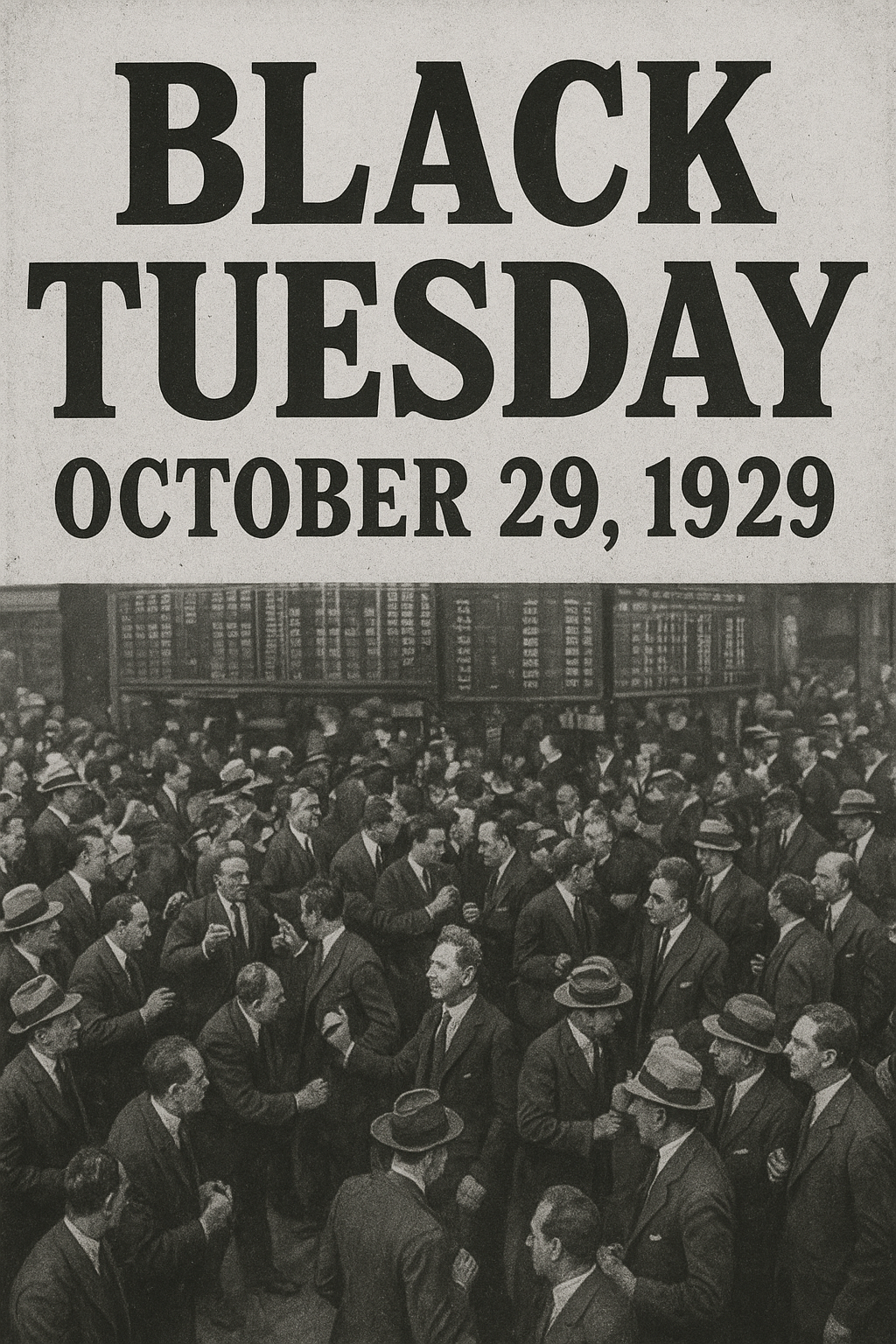
Black Tuesday: October 29, 1929
A Detailed Account of the Wall Street Crash That Triggered the Great Depression
The Broader Context: The Roaring Twenties and Speculative Mania
The crash did not occur in isolation. The 1920s had been a decade of unprecedented economic optimism in the United States:
Industrial Boom: Mass production (especially automobiles via Ford’s assembly line) and electrification transformed daily life.
Credit Expansion: Installment buying and margin loans allowed consumers and investors to purchase far beyond their cash reserves.
Stock Market Speculation: By 1929, margin buying was rampant, investors needed only 10–20% cash to buy stocks, borrowing the rest from brokers. This leveraged the market upward but made it fragile.
Radio Corporation of America (RCA) became the era’s tech darling, rising from $1 to $573 (split-adjusted) without ever paying a dividend—pure speculation.
Wealth Concentration: The top 1% owned ~24% of U.S. income; the bottom 80% shared ~40%. Consumer demand was artificially propped by credit.
By September 1929, warning signs emerged:
The Federal Reserve raised interest rates to curb speculation.
Industrial production began declining.
European economies, still recovering from WWI, reduced U.S. exports.
Yet the market peaked on September 3, 1929, with the Dow Jones Industrial Average (DJIA) closing at 381.17.
The Prelude: Black Thursday (October 24)
The first crack appeared five days before Black Tuesday.
Margin Calls: As prices dipped in late October, brokers demanded additional collateral from leveraged investors.
Panic Selling Begins: By midday, the ticker tape lagged hours behind trades. Rumors spread of bankruptcies.
Volume Surge: 12.9 million shares traded (triple the norm).
Banker Intervention: J.P. Morgan, National City Bank, and Chase formed a $240 million pool to buy blue-chip stocks and stabilize prices. Richard Whitney (acting NYSE president) famously bid $205 for U.S. Steel (above market) to signal confidence.
The market closed down but orderly. The DJIA fell ~9% (33 points). Temporary calm returned.
Black Monday (October 28): The Dam Breaks
The banker rescue failed to restore confidence.
Selling Resumed: Investors who survived Thursday’s margin calls now dumped shares to avoid further losses.
No Buyer Support: The banking consortium withdrew, believing the market needed to “purge excess.”
Record Volume: 9.25 million shares traded.
DJIA Plunge: Closed at 298.97, down 38.33 points (~13%).
The ticker fell four hours behind. Telephone lines to brokerage houses were jammed. Crowds gathered outside 23 Wall Street in stunned silence.
Black Tuesday (October 29): Cataclysm
October 29, 1929, remains the most infamous single day in Wall Street history.
Metric Value
Opening Bell 9:30 AM – immediate sell-off
Shares Traded 16,410,030 (record)
DJIA Close 230.07
Point Drop –68.90 (~12%)
Two-Day Loss (Mon–Tue) –23%
Loss Since Sept Peak –40%
Timeline of the Day
Time Event
9:30 AM Exchange opens; sell orders flood in. No buyers.
10:00 AM Ticker already 90 minutes behind. Brokers scream orders in the pit.
11:00 AM U.S. Steel drops from $180 to $150. General Electric falls 50%.
12:00 PM Winston Churchill, visiting NYSE, witnesses the chaos firsthand.
1:00 PM Ticker four hours behind; many investors unaware of current prices.
3:00 PM Final bell. Exchange floor littered with torn paper.
Margin Liquidation Spiral: Brokers sold stocks to cover loans, driving prices lower, triggering more margin calls.
Bank Runs Begin: Depositors, fearing bank insolvency (many banks owned stocks), began withdrawing cash.
Suicides: Mythologized but largely untrue—only one verified suicide on Wall Street (a clerk). However, 23 suicides were reported nationwide in October 1929 (vs. 17 average).
Immediate Aftermath
Impact Details
Wealth Destruction $30 billion lost in two days ($500 billion in 2025 dollars).
Brokerage Failures Hundreds of firms collapsed; customer accounts wiped out.
Bank Closures ~650 banks failed in 1929 alone; thousands more by 1933.
Unemployment Rose from 3% (1929) to 25% (1933); 15 million jobless.
Global Ripple U.S. called in foreign loans; Europe defaulted; world trade fell 66%.
Why It Wasn’t Just a “Stock Market Crash”
The crash exposed structural flaws:
Over-Leveraged Economy – Margin debt reached $8.5 billion (more than total U.S. currency in circulation).
Banking Fragility – No FDIC; banks invested depositors’ money in stocks.
Inequality – When credit dried up, working-class consumption collapsed.
Policy Errors – Fed tightened money supply; Smoot-Hawley Tariff (1930) crushed exports.
Long-Term Consequences & Reforms
Reform Year Purpose
Glass-Steagall Act 1933 Separated commercial & investment banking
Securities Exchange Act 1934 Created SEC to regulate markets
FDIC 1933 Insured bank deposits
Margin Requirements 1934 Raised to 50% (today: 50% initial, 25% maint.)
VIII. Cultural Legacy
“Black Tuesday” entered lexicon as synonym for financial disaster.
John Kenneth Galbraith’s The Great Crash, 1929 (1954) remains the definitive account.
The event inspired:
Literature: The Grapes of Wrath (Steinbeck)
Film: Cinderella Man (2005)
Music: “Brother, Can You Spare a Dime?” (1932)
Could It Happen Again?
Modern safeguards reduce risk, but flash crashes (e.g., May 6, 2010) and meme stock frenzies (2021) echo 1929’s volatility. Key differences:
1929 Today
No circuit breakers 7%, 13%, 20% halts
No deposit insurance FDIC up to $250,000
Ticker tape delay High-frequency trading (microseconds)
10% margin 50% Reg T
Yet leverage via derivatives and algorithmic trading create new systemic risks.
Final Note
Black Tuesday was not the cause of the Great Depression but its catalyst. It shattered the illusion of perpetual prosperity, exposed deep economic fractures, and forced a reckoning with unregulated capitalism. As economist Irving Fisher infamously said days before the crash: “Stock prices have reached what looks like a permanently high plateau.”
He was wrong and the world paid the price.